Friday, September 3, 2021

The Women of the Aberystwyth ARP

This blog is as much a plea for help as a history. Researching the contribution of the women of Aberystwyth concludes with the sad though that many were indeed ‘Hidden from History’; including those who made such an effort to patrol the streets and help safeguard the town.  
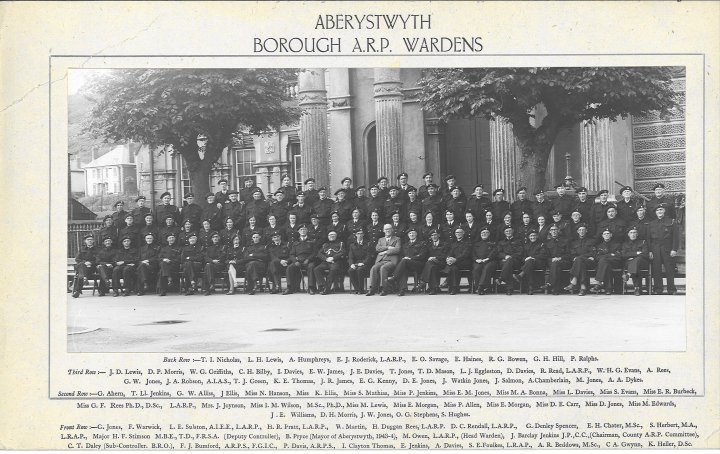
 

Image Archify Ceredigion Archives


The Women's Voluntary Service (W.V.S.), formed in June 1938, was tasked to recruit and train women for various ARP duties. As you can see from the above photograph, third of the Aberystwyth ARP were women. They represent a fusion between the university and the town. For all the men in the photograph, the census records ‘ARP Warden’ by their names. Not so for the women; across Britain there are no archival lists of ARP wardens. Neither the National Archives nor the Imperial War Museum can help but if you spot one of your forebears, or someone you knew, in the photograph, please get in touch. That will help us to give credit where it is due and show the significance of the work of these women.

The generational fashion for the use of particular first names has made census and electoral data tricky to unravel. For example, which of the sixteen women called M. Edwards, all born around the same time, is the one in the photograph?  It has been easier to track down scant details about some ARP wardens who did not change their names through marriage, as in the women featured below.


G. Denley Spencer (Front Row, 8th from the left)


Alice Gwendoline Denley Spencer was born on 21 August 1908 in Aberystwyth and Baptised in Holy Trinity Church. Daughter of John Denley Spencer, born in Covington Kentucky, USA, in 1869, and Alice Annie Spencer, born in Chester in 1874. Alice Gwendoline had a brother eleven years older than her, Thos Hamphrey, and a sister a year younger, Marjorie. It seems another brother, the Denley Spencer’s second son John Dennis, born in 1894, had died aged just seven in Aberystwyth.

There must be an interesting story as to why John Denley Spencer moved to Wales from a booming city in the USA. Covington had a population of 743 in 1830 and had grown to a population of 42,938 in 1900. He was publisher for the Montgomery County Times and Shropshire and Mid-Wales Advertiser from his branch office in Chalybeate Street Aberystwyth. The first edition was published on 1 July 1893.

In 1939 Alice was living in the family home, Highfield, Dinas Terrace. Her occupation is recorded as a beauty specialist. She is the sole woman on the front row of the ARP Wardens’ photograph, something that presents an interesting conundrum. She is also the only woman who is not recorded as ‘Miss’, and why is she on the front row? If she had a particular role within Aberystwyth ARP, no record of that role is accessible. Was it because her father was a journalist and printer, the person printing the newspaper in which the photograph was printed? The Women’s Royal Voluntary Service recruited women for ARP duties. Was Alice the WRTVS official who recruited the other women? Unless someone can fill in the gaps, we are left to speculate.  Alice was still living in Aberystwyth when she died in 1990, aged 81.

Miss Sally E Mathias (Second Row, 7th from the left)


Sally E Mathias was born in Aberystwyth on 16th June 1903. She worked as a cashier in an Aberystwyth cinema during WWII. It is not clear whether she was employed in the Coliseum, now the home of Ceredigion Museum, or the Pier Cinema. In the first week of the war, in September 1939, the BBC reported that all places of entertainment were closed on the orders of the Home Office. Aberystwyth was the only town in Great Britain to ignore the instruction and cinemas remained open. Ceredigion Museum holds a priceless photograph depicting would-be cinema goers in London who were confronted by a notice showing an arrow, pointing toward Aberystwyth, telling them it was 239 miles to the nearest cinema open that evening. The government climbed down; all venues opened again by the weekend. 
 
Image Amgueddfa Ceredgion Museum


We can imagine Sally wending her way home from work, after the last film, easily able to spot any shafts of light escaping from windows along the way. Her home, which she shared with her father, Thomas C Mathias, and her younger sister Rachel E Mathias, was at Glan-Hafan, Pen-yr-Angor. Those homes since demolished and replaced by a more modern estate. She died in 1978 and is buried in Plascrug Cemetery, Aberystwyth. 


Miss I M Wilson, MSc, PhD (Second Row, 16th from the left)


Born on 10 May 1904, Irene lived during the Second World War at 11 South Marine Terrace.  Irene was welcomed to Aberystwyth University in October 1936, when she arrived from London having already been awarded a MSc. Her role is recorded, in the 1939 Report to the Court of Aberystwyth University Governors about College Staff, as a Demonstrator in Botany. She is praised for her role in conducting field work excursions to North Wales, where first year Honours students observed inland and coastal floras.   Irene was a specialist in ‘peziza rutilans’ an orange fungus which grows on soil, in particular its cytology, its cell-structure. In 1937 she presented a paper in Nottingham and its publication coincided with her PhD (London) award. Irene was busy publishing in academic journals during WWII.


Miss D E Carr (Second Row, 8th from the right)


Doris E Carr lived at 1 Maesheli, Penparke during the war. The only available record of Doris suggests that she married a Peter M Devereux in north Ceredigion in January 1960. More speculation, the Devereux’s seem to have come from Ireland. Was Peter one of the Irish workers who moved to Wales during WWII?

Miss Kathleen Ellis (Second Row, 6th from the left)


Kathleen was born on 3 September 1903 and is recorded as attending Alexandra Road Board School in 1908. Alexandra Road School was built in 1874 for 600 children aged 5-14. There were boys’, girls’ and infants’ departments, all with their own headteachers.  During WWII she is listed as a single person, living at 15 Portland Street. Her occupation is recorded as ‘domestic home duties’. Clearly her sense of duty far exceeded that modest description.  

Miss (Florence Gwendoline) Rees D.Sc, FRS. (Second Row, 14th from left.)


Incorrectly recorded on the ARP photography caption as Miss G. R. Rees, Gwen was an eminent Welsh scientist. Born on 3 July 1906 in Abercynon, she was the younger daughter of Ebenezer Rees (1865-1948) and Elizabeth Agnes (nee Jones) of Cilybebyll (1877-1921). On Gwen’s father’s appointment as Superintendent of Police, the family moved to Aberdare. Educated at Abercynon Intermediate School for Girls from 1918-24, Gwen went on to study chemistry, biology and zoology at Cardiff University. Her doctorate in zoology was awarded in 1930, after just eighteen months’ research. It established her expertise as a parasitologist researching trematode parasites in snails - her science was literally down to earth, involving the collection of snails. She is said to have collected more than 5,000 for her research, from 90 locations in Glamorgan and Monmouthshire. Focused on the practical, Gwen endeavoured to find a scientific solution to the problem of infested snails which were causing liver fluke disease across flocks of sheep.

Meticulous attention to detail and faultless scientific method were the hallmarks of Gwen’s work. Of significance beyond the life of snails, and hours spent foraging in Welsh fields, Gwen developed a wide understanding about the relationship of parasites to their hosts. Whilst she delivered lectures abroad, she was too modest to accept the posts she was offered to spend a year in some overseas universities. She appeared in ‘Vogue’ magazine, in 1975, as shown in the above photograph, in an article about influential female scientists.  

Appointed to the Zoology Department of Aberystwyth University in 1930, she was a lecturer throughout the Second World War, progressing to the post of Professor in 1971, after she became the first Welsh woman to be elected as a Fellow of the Royal Society. The Linnean Society presented her with their medal for services to zoology in 1990.  Gwen lived at Grey Mist, North Road, Aberystwyth for the rest of her life. She died on 4 October 1994 in Penglais Hospital.

Blog by Alison Elliott


Monday, August 16, 2021

To mark VJ Day 15th August: 'Strange Living - authentic story of a Aberystwyth Repatriate'

On the same day as the bombing in Pearl Harbour, the Japanese had started their invasion of the Malayan peninsular, threatening Singapore. Captain Richard George Read, a veteran of WWI, had re-enlisted in 1939 with the 102nd Field Regiment, Royal Artillery, at Aberystwyth, having already spent 25 years in the Royal Horse Artillery. Early in 1941, he transferred to the 118th Field Regiment Royal Artillery, part of the newly formed 18th Division, which was to depart the UK late in 1941 bound for the War in the Middle East. However during their journey Winston Churchill decided to send them to the Far East, the war there was not going well there at his point, and Churchill had decided to send additional troops to bolster the defences and hold off any invading forces.

As with the rest of the 18th Division, the 118th were not prepared, trained nor did they have the correct equipment for war in the Far East, nevertheless they landed on 29th January 1942 during Japanese bombing raids of the harbour and , little did they know at the time, just days before the British Surrender on the 15th February 1942. On the 15th February 1942, the British and Commonwealth troops finally surrendered to the invading Japanese troops. The Japanese Commander, Lieut-General Yamashita had successfully led his 30,000 troops to overcome the 85,000 defending allied troops on Singapore.

To this day , it was the largest surrender of British led forces in history. Winston Churchill called it ‘the worst disaster’ in British Military History.

And so started three and a half years as a prisoner of war for my Great Grandfather along with 140,000 Commonwealth troops. The Japanese had refused to sign up to the Geneva convention and many of the camp guards were notorious for their acts of cruelty to their prisoners, the Japanese used the prisoners as slave labour, either on the infamous ‘Death Railway’ built by the POWs between Burma and Thailand or in Japan or their invaded territories.

My Great Grandfather was fortunate to survive the ordeal and was shipped back after the Japanese surrendered in August 1945. Upon his return to the UK in late November 1945, he caught the train home to Aberystwyth. I have an original copy of a Cambrian News article dated 7th December 1945 telling of my Great Grandfathers return and his time as a POW, transcribed below, where he was given a hero's welcome by the town and dignitaries. 

He had never really recovered from his ordeal as a Prisoner though, and in August 1946, he was rushed to Chester Military Hospital again, suffering from what was later found out to be stomach cancer, he died there on the 26th September 1946. He is commemorated on Llanbadarn Fawr War Memorial.


'Strange Living - Life in a Jap Camp - authentic story of a Aberystwyth Repatriate'

Thanks to the National Library and the Cambrian News for permission to reprint this article


 Transcript

'Strange oddities like snakes and snails being used as foodstuffs and secret listening to the B.B.C. News from wireless sets installed in water bottles and tin cans, these and other thrills were all packed into the life of Capt. Richd. George Read, 3 The Broadway, Llangawsai ,Aberystwyth, whilst a prisoner-of war in the Far East.

Capt. Read arrived home on Wednesday week, and was given a tumultuous reception at the Aberystwyth Station. Owing to misunderstanding his wife, who had travelled to meet him at Shrewsbury, was not present, as the train that carried her husband was not the one expected. Capt. Reed was, however, met at the Station by his two daughters the Misses Eileen and Mary Read, who incidentally, he said, "I could hardly recognise, they had altered so much in that comparatively short time."

En route from Singapore to Madras on the SS Rajula, Capt Read met Dr. J. M. Cribbs, the ship's medical officer, who, prior to enlisting, was in practice at Aberystwyth, and will be well remembered by the residents. At Bangalore, India, the ex-prisoners were very well looked after and cared for by the Red Cross, and thorough overhaul was given to each man, and it was estimated then they left that most of them had gained about two stone in weight. Capt. Read sailed home on H.M.S. Llandovery Castle, and arrived at Southampton on Nov. 4th, whence he was moved to Chester Military Hospital before finally being supplied with clothing coupons and such like effects at a Liverpool camp to pre- pare him for a new life in his own country.

Capt. Read, who joined the Army in 1914 as a trumpeter in the Royal Horse Artillery, has now completed 32 years with the Colours and was Lt.-Quarter-master to the 146 Field Regiment at Aberystwyth in 1939. He left this country from Liverpool in October,1941, is the SS Arcadia, and sailed across the Atlantic to Halifax, Nova Scotia, where the whole company disembarked and boarded the SS America, renamed West Point, which was Americas largest liner. After visiting Cape Town, where the local organisations gave them grand welcome, the troops to whom Capt. Read was attached were given hardening-up training course for three weeks about 100 miles inland from Bombay. Finally, he and his comrades arrived at Singapore on January 29th, 1942, and were subject to heavy aerial bombardment before being captured on Feb. 15th. 

Spending most of his time as captive in Changi Camp, with but a brief spell at Towner Road Camp, both in the vicinity of Singapore, Capt. Read said that beriberi broke out in March,1942. This was followed by skin troubles, eye ailments, diphtheria and general malnutrition, in spite of the prisoner's efforts in local gardens, which covered about 150 acres of land, where the captives grew as much as possible of green produce and tapioca, Ceylon spinach, etc. As food supplies decreased the health of the whole camp deteriorated; the fish that was sent in was rotten, but prisoners ate it, including the heads At this stage, Capt Read recalled the wonderful moral of the prisoners, "In spite of the shortage of food and clothing," he said, "We always knew that were on top. and the end for which we all prayed came about by our people arriving and the Japs capitulating. Whilst prisoner of war, we knew that the spirits of the people at home were such that it enabled us to keep our own high."

Referring to the hidden wireless sets, Cap Read said that they wore made from odd pieces which the men from wireless vans whilst on fatigues and were made secretly in the camp. During the whole time Japanese guards made regular searches, but all proved fruitless.  Speaking on the brighter side of their lives, he said that the British and Australians made up good concert parties, and the Japanese did allow the prisoners to buy material for making instruments, many of which that were used in the orchestra were made by the men, such as basses, 'cellos, guitars, flutes and yin whistles.

As food went down in scale, the officers complained and the Japanese reduced the deductions for food and accommodation, instead of increasing the ration. They invested the remainder of the prisoners work pay, and when their country capitulated they wanted to pay using this money, but their money was worthless. "I might add' , said Capt. Read, that most of our valuables, such an watches, cigarette cases, lighters, and pens were sold to get food, much of which was obtained through the black market of the Chinese."

Capt. Read was met Aberystwyth Station by the Mayor and Mayoress (Cllr. and Mrs. A. W. Miller), the Deputy Mayor and Mayoress (Cllr. and Mrs. Griffith Davies), Cllr. Emile T. Evans, and a host of old friends and acquaintances. In a car he was slowly driven to his home, where the neighbours had prepared the street with lighting flags, and for a part of the journey headed by the Army Cadet Band, in charge of Drum Major H. Humphreys. “Speaking as an old soldier, said Capt. Read, "I admired very much the turn out of the Band, both their turn out and drill." Capt. Read wishes to thank everyone for their kindness and good wishes. “I was really and truly struck by the wonderful reception” he said.'

Blog by Simon Burgess

Author's website : https://www.richardgeorgeread.com/

Tuesday, August 3, 2021

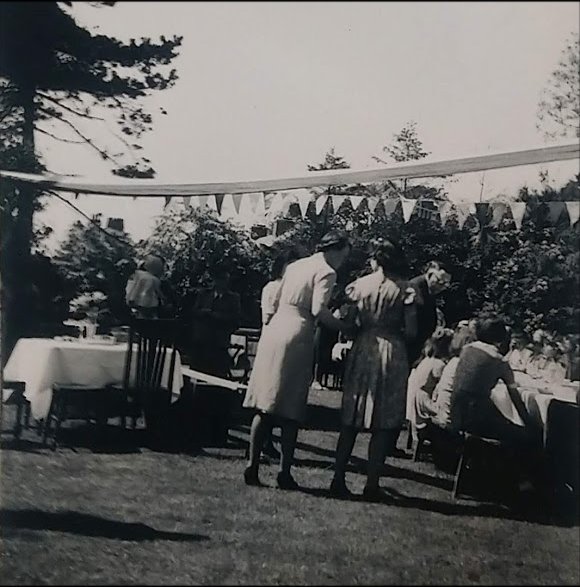
VE Day celebration party 1945 in Llangawsai, Llanbadarn Fawr

These photos were taken my my Grandmother Eileen Read (or possibly her sister, Mary) who lived in Broadway Llangawsai, Llanbadarn Fawr.


Taken at a VE day party in May 1945, celebrating the end of hostilities in Europe, though an occasion to celebrate, this must have been especially poignant to the family as Eileen and Mary's father (husband of their mum Daisy) Richard was still a Prisoner of War (POW) of the Japanese at the time. and was to remain overseas until finally arriving home back in Aberystwyth in December 1945.


Sometimes known as 'The forgotten army', the War in the Far East continued for many months after the war ended in Europe. People were eager to move on with the lives after so many years of hardship, which meant that by the time of the end of fighting in the Far East, those arriving home were often not given the heroes welcome that they expected. Many POW's of the Japanese were given strict instructions by the Government to 'Guard your tongue' specifically instructing them not to speak of the horrific experiences that they had endured, leading to many keeping their experiences to themselves, with families of the prisoners often having to deal with the aftermath.


VE Day 1945 in Mrs Evans' Brynteg
 

If you or any of your family were present at the Llanbadarn VE celebration in 1945, or if you recognize anyone in these photographs, Simon would like to hear from you. Please get in touch with him via his website :  https://www.richardgeorgeread.com/contact 

Blog by Simon Burgess 

Wednesday, July 14, 2021

Salvage for Victory!

We are all very used to the constant publicity about the need to recycle as many materials as possible to help the environment.  What we may not realise was that from 1940 onwards householders in Aberystwyth were being urged to do the same but, at that time, to help the war effort.

At the end of December 1939, the British government established the National Salvage Campaign. Memories were still strong of the severe shortages of materials and the consequent rises in price which occurred at the end of the First World War and there was naturally a desire to prevent this happening again. The government through the Ministry of Supply informed local authorities about what they were expected to do in a series of circulars about the salvaging (or recycling) of refuse which were sent out regularly throughout the war.

Aberystwyth Borough Council discussed the first circular on 12th January 1940. This was an appeal to local authorities to improve their refuse collection services and to separate out paper, rags, metals and foodstuffs from other waste material. At this stage, the Ministry was only requesting co-operation in this undertaking, but in June 1940 it became compulsory for all local authorities with populations of over 10,000 to offer efficient salvage collection.

The collection of the main materials was far from easy to arrange. Not least of these difficulties was the job of convincing householders of the importance of saving waste materials and then motivating them to carry it out. Then practical arrangements had to be made for the waste to be collected from houses and stored somewhere until it was sold. As a last step, the Council was responsible for finding where to sell its salvage for the best price by putting out tenders to a variety of companies for each type of waste.  The single most important material right from the start was the collection of paper which was re-pulped and reused.

By the end of February 1940, after consulting with other local authorities about how best to go about setting up a salvage scheme, Aberystwyth Council came up with the following plan:

•    To try out for three months the salvaging of paper using the saleroom in the Smithfield and to offer the paper for sale to the Cambrian News 

•    To obtain quotations for purchasing a paper baler and tin baler

•    To prepare 3,000 leaflets with instructions to householders which would be distributed by refuse collectors.

Two months later the council had set up arrangements to collect rags, scrap metal, bones and bottles in addition to paper. The places selected for storing the salvage were the Smithfield and Domen Dre. Waste food stuff collections to provide food for livestock were on the list provided by the Ministry of Supply but this was not undertaken in Aberystwyth as farmers had already started their own scheme.  

At a meeting on 24th May 1940, the Borough Surveyor was able to report that he had managed to sell two and a half tons of paper for £4 a ton. At the same meeting there was discussion over approaching the Vicar of St Michael’s Church about the possibility of removing the railings at St Michael’s Churchyard to be used for scrap. Later in the year there were several attempts to identify other railings in the town that could be similarly used but apart from a few on the Castle Grounds not many others appear to have been removed.

From the beginning of the salvage scheme, the Council also had the problem of finding a way to transport the collected waste.  They were helped out in the short term by Hancock's Brewery of the White Horse Hotel who generously offered the use of their lorry and one man free of charge for two days a week.

In July 1940, the District Advisor of the Ministry of Supply (Salvage) visited Aberystwyth and the meeting he held with the recently formed Salvage Sub-Committee reflected the key role of women in the salvage scheme.  A number of women’s groups in the town were invited to attend, including the Women’s Voluntary Service (WVS), the Women’s Institute, Penparcau and The Women’s Cooperative Guild. The Advisor also arranged to give a talk in one or two schools to get children involved.  

As a result, the following month a Women’s Salvage Committee was established in the town with Mrs K.P.Davies of the WVS appointed as organiser. Following another Ministry Circular, Number 27, women’s organisations in the town were asked to carry out a house-to-house canvass about the importance of salvaging and how to do it. The campaign not only encouraged members of the public to save their materials by approaching individuals directly but the women also organised the collection of the salvage from houses - something that that council seems to have been reluctant to do because of the cost.  As well as the obvious practical benefit of increasing amounts of salvage, this approach was also an important way of boosting morale by showing exactly what those at home could do and how their contribution could make a real difference to the war effort. 

Huge publicity campaigns were conducted on the radio, in cinemas, in newspapers together with many posters and leaflets which had varying degrees of success. Below are two examples:
 

Three generations of women contributing to the war effort, August 1941, IWM

Poster showing how salvage materials were used to build a bomber, IWM

By July 1941, the Labour Superintendent of the Council (now in charge of refuse and salvage collection) was asked to provide a monthly report on the collection of salvage.  Here is a typical report submitted in April 1942:


Various means were used to try to maintain public support and commitment to the cause. A salvage slogan competition was organised by Aberystwyth Borough Council in 1941 with a prize of one guinea for the winner. It was shared between Miss P. Davies of Elysian Grove and Miss Bradshaw of Penglais Farm. Unfortunately, there is no record in the minutes of what the winning slogans were but it was noted that they were used to produce two slides for exhibition at local cinemas at the Council’s expense and the WVS organiser, Mrs K.P. Davies, was invited to speak at cinemas showing them.

Competitions seem to have been a popular way to focus the public’s attention on the importance of salvaging. 1942 saw the launch of a national contest to see how much waste paper could be collected between 1st January and 31st.  The prize on offer was £20,000. Aberystwyth Borough Council seems to have been keen to participate in this, asking headmasters to arrange for children to help with the collection and placing advertisements in local papers. The manager of Howells was thanked for offering the use of the window space in his shop to advertise the campaign and other retailers in the town followed suit.  Later in the month the Borough Accountant was asked to dispose of obsolete records that could be added to the paper salvage. The mayor went so far as to make a request that schoolchildren at elementary schools in the borough be given a day off on 30th January to assist in the salvage drive There was no mention in the Council’s minutes of the outcome so presumably Aberystwyth did not win a prize.

In February 1942, Circular No. 70 from the Ministry arrived in in the town. This contained the suggestion of appointing volunteer Salvage Stewards to help increase the amount of salvage collected. Many of these stewards in Aberystwyth were once again recruited from the WVS, and the organisation was made responsible for advertising for people to join. The role of the stewards was to provide support to their local community - ideally one individual appointed to a street - to encourage people to collect waste, how to sort it and also to give feedback to the local authority about where improvements to the system could be made.   The stewards were given a certificate and a badge as shown below.


Early in 1943 the possibility was raised by Mr Read of the Cambrian News that the Borough of Aberystwyth together with the Rural District should plan a Book Drive. This idea was something apart from the ordinary salvage scheme but the salvage scheme would benefit by receiving the books that were not of special value nor of use to war-damaged libraries. In July 1944, the Town Clerk was instructed to find out where to send books collected for libraries that had been blitzed.

By May 1945, the Borough Council writing to the Ministry seems to have hoped that the need to continue collecting salvage might have come to an end, but they received the reply that their efforts were to continue. However, the local authority did receive a letter in September 1945 from the Ministry of Supply thanking them for their great help given throughout the war by means of their salvage schemes.  The same month salvage collections in the town were reduced to twice a week.

Salvage collection can be seen as an important contribution to the idea which is at the centre of our project – the people’s war. This concept came into use in 1940 – the idea of all citizens becoming combatants on the front line, contributing in a very real way to winning the war.

Blog by Frances Foley 

Sources: Borough of Aberystwyth Agendas and Minutes 1939 – 1945 by courtesy of Ceredigion Archives.


Wednesday, June 30, 2021

Aberystwyth ARP Wardens - part three

Here is the final part of our blog on some of the male ARP wardens. Watch this space for one on some of the female wardens over the coming months!


Photo/Llun: Archify Ceredigion Archives


BACK ROW (left to right)

 Thomas Islwyn Nicholas


Thomas Islwyn was born on 4th January 1903 the son of the famous poet, preacher and minister of the Welsh Independents at Horeb Chapel, Llandilo, Thomas Evan Nicholas. Thomas Evan was ordained on 6th Oct 1902, and continued to preach around South Wales, before going to live in Wisconsin for a year to continue his preaching. In 1903 the family returned to Wales eventually settling in Aberystwyth. Thomas Islwyn Nicholas married Mari Alice Rowlands in October 1926 and by 1939 became a dental mechanic in Aberystwyth, like his father and mother. In 1939 the couple lived at Glacoed, Elm Tree Avenue, Aberystwyth and by 1945 Thomas Islwyn was one of the ARP wardens of Aberystwyth.
He died on 7th August 1980 aged 77 years. 


Ernest John Haines


Ernest was born on 21st January 1909, the son of hotel worker John Haines. He served in WWI with the South Wales Borderers from 1914 to 1920. He married Edna Davies in January 1935 at Holy Trinity Church Aberystwyth and worked as a gardener. He was in the ARP in 1945 and lived at 6 Gogerddan Place, Aberystwyth. He died in 1962 aged 53 yrs.

THIRD ROW (left to right)

David Handel Morris 


David was born on 22nd August 1886 one of the large family of Margaretta and John Rees Morris who was a draper.  By 1911 David was an outfitter and lived 2 Princess Street, Aberystwyth.  On 22nd August 1917, on his 31st birthday, he joined both the Air Force and the Navy. The first ship he served on was HMS President and his last was HMS Turnhouse. By 1939 he was the owner of a drapers store and by 1945 he was an ARP Warden. David died on 8th February 1958 aged 72 years


Robert Henry Read L.A.R.P.  


Robert was born in Caernarfon in 1887 the son of journalist and author Henry W. Read.  He married Arabella in Cardiff on 8th September 1910 and by 1911 was working as a journalist.  By 1939 he was living at Myrtleville, St. David’s Road Aberystwyth, and was the managing editor of a newspaper.  He served in WWI with the Norfolk Regiment 7th Battalion from 1915 until 1919 and on 14th January1922 he was awarded the British War Medal. He died on 28th September 1947 aged 60 yrs.


Kenneth E. E. Thomas


Kenneth was born on 28th March 1893, the eldest of the five children of Thomas J. Thomas and Mary Thomas.  Kenneth’s father worked at the Government Dockyard in Pembrokeshire as a ship and engine fitter. The family lived at 16 North Street, Bufferland, Pembroke Dock.  In 1911 Kenneth was still living with his parents and family whilst he was working as a printer’s apprentice. Kenneth served in the Welsh Guards from 1914 to 1920 in the machine gun regiment. He married Mary Anne in 1929 and by 1939 he was working as an Inland Revenue Chief Inspector and lived at 1 First Avenue, Penparke.
Kenneth died in Cardigan in 1973 aged 80 years.


SECOND ROW (left to right)

John Davies Allen Ellis 


John was born 25th June 1866 in Lampeter. He married Mary Ann and had at least one son – David.
On 11th August 1914, David joined the Northamptonshire Regiment, but by 25th Sept 1914 he was discharged on health grounds. He then joined the South Wales Borderers, and was again discharged on health grounds. David sadly died on 13th May 1919 and is buried in St. Peter’s Church,Lampeter. In 1939 John lived at 6 Alfred Place, Aberystwyth and was a retired commercial traveller. He died on 24th Feb 1948 aged 82, outliving his son by 29 years.


Osborne Gwynnedon Stevens


Osborn was born in 1877 in Haverford West, the son of James Stephens, a builder from Pembroke. Osborne married Jane Ellen Richards on 20th December 1910 and in 1911 was a home painter.  He served in WWI, from 10th December 1915, in the Royal Engineers   He lived at 24 Pembroke Road Cardiff.  When the engineers were dispersed on 25th February 1919 he was awarded the Victory medal.   By 1939 he was living at 30 Third Avenue, Penparke. Osborne died in Aberystwyth in 1957 aged 80 years.

Joseph Salmon


Joseph was the son of railway engineer Joseph Salmon and was born on 16th March 1900. Joseph served in WWI with the Royal Welsh Fusiliers but was disabled. He married Hilda Cook in October 1925.   By 1939 he was Inn-keeper at the Cross Foxes, 17 Mill Street, Aberystwyth. In 1945 he was in the ARP and by 1965 had moved to 28 Queen Street, Aberystwyth. Joseph died at Tan-y-Bwlch, Hospital, Aberystwyth on 17th September 1965 aged 65 years.


Arthur Alexander Dykes


Arthur was born on 25the October 1887 and married Virginia Waters in 1920.  During WWI he served with the Battery Royal Field Artillery as a driver. After the war, he worked for the non-industrial Ministry of Agriculture and Fisheries. By 1945 he was living at 33 Third Avenue, Penparke, and was a member of the A.R.P.  Arthur died on 29the November 1968 aged 81 yrs.


Blog by Kath Phillips

Tuesday, June 15, 2021

Aberystwyth ARP Wardens - part two


Ffoto/Photo: Archifdy Ceredigion Archives


Following on from our blog of last time, below are some of the male ARP wardens that feature in the front row of the above photo:

Leonard Edwin Sulston 

Leonard was born in Charing Kent, the son of Jonas Sulston and Rosa A. Wells.  He married Dorothy Matilda Husselbee in July 1922 in St. Georges Hanover Square.  In 1911 he was an electrical engineer improver.  He Graduated in 1923, and then worked in the Physics Laboratory at U.C.W.A. By 1945 he was in the A.R.P. with Aberystwyth Borough. He died at Tan y Bwlch Hospital on 8th September 1959 aged 67yrs.

David Cromarty Rendell LARP  


David was born on 26th February 1896 in Monmouthshire, the son of John Rendell, who was a colliery labourer below ground. David worked as a sewing machine cleaner and then joined the Military aged just 19 in 1916.   David was in the Machine Gun Corps in 1920 and was awarded the U.K. Silver Badge. In 1921 he married Annie S. J. and moved to Aberystwyth in about 1935 and lived at the Corn Hotel, Mill Street, Aberystwyth.  By September 1941 he had married his second wife, Olive Margaret Haget. By 1945 he was in the ARP. He died in March 1966 aged 70 yrs.
 

Edward Hubert Chater 


Edward was born in St. Marylebone on 8th December 1902, the son of Edward Wilson Chater, a solicitor of the Supreme Court.  He married Margaret Hutchinson in 1931 in Hastings, and sometime later he moved to Wales and became a lecturer in Biology at U.C.W.A.  By 1945 he was living at Windover, Penrhyn Anchor, and was in the A.R.P.

Sydney Charles Herbert 


Sydney was born on 13th January 1886 at St. Martin in the Fields, the son of William Henry Herbert, who was a collector of Royal Statistics. He married Ellen in 1909 and by 1911 lived in Camberwell Surrey. By 1939 they had moved to 7, Marine Terrace and Sydney was a senior lecturer at U.C.W.A.  By 1945 he was in the ARP. He died on 7th December 1967 in Aberystwyth aged 81 years.

Major Horace Frederick Stimson T.D. F.R.S.A    


Frederick was born in 1885 in Peterborough, the son of a Railway train engineer, Samuel Stimson. He married firstly Eleanor Parkin 1912, and secondly Edith Richardson in 1944.  By 1944 he lived at Maldwyn, Caradog Road, Aberystwyth.  He was a lecturer in P.E. at U.W.A. and was also a Major in the T.A. at least during 1939-1945, and was decorated.  By 1945 he was the Chief Executive Officer of the ARP. Stimson T./Lt(A./Capt) holds the British Army WW1 medal as well as WWI and WWII Shipping and Seamen Rolls of Honour.  He died on 20th June 1954 at the Royal Masonic Hospital, Ravenscourt, London W6 aged 69 yrs.
 

Morgan J. Owen 


Morgan was born in Aberystwyth in 1890, the son of John Owen, who was a carpenter, joiner and undertaker living at 1 Rheidol Terrace Aberystwyth. Morgan married Elizabeth Griffiths in September 1922 and by 1939 lived at 10 Rheidol Terrace Aberystwyth.  He worked as a clerk of building works. From 1914 until 1920 he served in WWI with the South Wales Borderers and was awarded both the British War Medal and the Victory Medal. By 1945 he was the head of ARP Wardens.

Cyril Thomas Daley 


Born in Hammersmith in 1891, the son of Julia and Thomas Daley, who was a tobacconist.  Cyril was a piano tuner in1914 before he joined the Royal Army Medical Corps in which is served from 28th August to 29th November 1914, when he was discharged as unfit for service. In 1919 he married Gwladys M. Lewes in Carmarthen. By 1939 he lived at College House, King Street, Aberystwyth, whilst Gwladys was living at 45 Marine Terrace, Aberystwyth. He was the proprietor of a piano music business. By 1945 he was the ARP Sub controller, Central Area. He died in 1962 aged 61 years and is buried in Llanerchaeron, Ceredigion.
 

Frederick Joseph Bumford  


Frederick was born on 21st January 1897, the sixth of ten children of Martha E Bellis and Thomas Henry Bumford,  who was a foreman blender in wool manufacture.  The family lived at Dolafon House in Newtown, and Fred eventually became a yarn plasterer in 1911 aged 14 years.  At the outbreak of WWI Fred, aged 17, joined up with the Welsh Fusiliers in 1914 and stayed in the Military until 1919.
Hed married Gwyneth in December 1925 and by 1939 had moved to Aberystwyth and lived at 25 Third Avenue, Penparke by 1945. By 1945 he was in the A.R.P.  Fred died on 02/06/1959 in Aberystwyth aged 62 years.
 

Isaac Clayton Thomas 


Isaac was born on 28th Sept 1890, the son of Betsey and Mariner James Thomas, who lived at 4, Shipbuilders Row, Aberystwyth. He married Mary Jane on 2nd December 1903 and they lived at Britannia, 13 High Street Aberystwyth.  By 1911 he was a Civil Servant working for the P.O.
In 1914 he started working for the Military as a Sapper with the Royal Engineers. He was discharged in 1920 and was awarded both the British War medal and the Victory Medal. He died on 28th March 1955 at Withybush Hospital, Pembrokeshire aged 65 years.
 

 Sydney Edward Foulkes 


Sydney was the son of Rose and William Robert Foulkes, who was a cotton warehouse man. He was born on 5th April1904 and lived at 19 Beech Street Salford Lancashire in1911. He married Florence Catherine Page in 1932 and by 1937 he had moved and lived at Sandown, Rheidol Road, Penparke.and his work was as an insurance inspector.  By 1945 he was in the ARP. He died on 26/04 1973 in Aberystwyth aged 69 years.

Blog by Kath Phillips


Wednesday, June 2, 2021

Aberystwyth Borough ARP Wardens

Ceredigion Archives, one of our partners in the project, has made available to us  a photograph of the Aberystwyth Borough ARP wardens, taken during WWII, complete with the names of the personnel written underneath.  Their roles within the APR are also noted and, in the case of those associated with the  University, their academic qualifications.  As might be expected, they are mostly men but there are also twenty women among their number.  A couple of our wonderful project volunteers are currently researching these men and women to find out a little bit more about them, and we'll be posting their findings here over the coming weeks. In the meantime, here is the photograph and the names of the personnel are transcribed underneath. 


Llun trwy gwrteisi Archifdy Ceredigion / Photo courtesy of Ceredigion Archives
 
 
Front row: G. Jones; F. Warwick; L.E. Sulston A.I.E.E., L.A.R.P; H.R.Pratt L.A.R.P; W. Martin; H. Duggan Rees L.A.R.P.; D.C. Rendell L.A.R.P.; G. Denley Spencer; E. H. Chater M.Sc; S. Herbert L.A.R.P.; Major H.F. Stimson MBE TD FRSA (Deputy Controller); B. Pryse (Mayor of Aberystwyth); M. Owen L.A.R.P. (Head Warden); J. Barclay Jenkins J.P., C.C.; (Chairman, County A.R.P.); C.T. Daley (Sub Controller, B.R.O); F. J. Bumford A.R.P.S.  E. G.I.C.; P. Davies A.R.P.S.; I. Clayton Thomas; E. Jenkins; A. Davies; S. E. Foulkes L.R.A.P.; A.R. Beddows M.Sc.; C.A. Gwynn; K. Heller.


Second row: G. Ahern; T. Ll. Jenkins; G.A. Aliss; J. Ellis; Miss N. Hanson; Miss K. Ellis; Miss S. Mathias; Miss P. Jenkins; Miss E. M. Jones; Miss M. A. Bonna; Miss L. Davies; Miss S. Evans; Miss E. R. Burbeck; Miss G. F. Rhys, Ph.D., D.Sc., L.A.R.P; Mrs J. Joynson; Miss I. M. Wilson, M.Sc., Ph.D.; Miss M. Lewis; Miss E. Morgan; Miss P. Allen; Miss E. Morgan; Miss D.E. Carr; Miss D. Jones; Miss M. Edwards; J.E. Williams; D. H. Morris; J. W. Jones; O.G. Stephens; S. Hughes.


Third row: J.D. Lewis; D.P. Morris; W.G. Griffiths; C.H. Bilby; J. Davies; E. W. James; J.E. Davies; T. Jones; T.D. Mason; L. J. Egglestone; D. Davies; R. Read L.A.R.P.; W. H. G. Evans; A.    Rees; G.W. Jones; J.A. Robson A.I.A.S; T. J. Green; K.E. Thomas; J.R. James; E.G.Kenny; D.E.Jones; J. Watkin Jones; J. Salmon; A. Chamberlain; M. Jones; A.A. Dykes.


Backrow: T. I. Nicholas; I.H. Lewis; A.    Humphreys; E. J. Roderick L.A.R.P.; E.O. Savage; E. Haines; R.G. Bowen; G. H. Hill; P. Ralphs.


Kate Sullivan 

Project Coordinator


From "Refugees" to "Enemy Aliens" ~ Part Six

  Germans, Austrians and Czechs at Pantgwyn and in the Domestic Services in Aberystwyth and the surrounding areas during the Second World Wa...